Mechanism Registries Are the Unit of Compounding Institutional Learning

Six months ago, my research pipeline produced 47 recommendations. An audit last month found 12 of them had been forgotten. The recommendations were not wrong. They were not stored in a way that survived the team's attention span. The insights were real. The format they were stored in could not keep them alive.
The graveyard every operations team has
Every improvement program I have worked with has the same archive: a folder of retrospectives that changed nothing, a batch of pilot results that never got a second read, a set of process improvements that held for a quarter and then quietly drifted back to the old pattern.
The common explanation is culture: "people don't follow through," "the team isn't disciplined about change," "leadership didn't reinforce it." That diagnosis feels plausible, but it is usually wrong. In most cases the team did the work. The work produced a real finding. The finding was then stored as prose, and prose decays.
A story captured in a retrospective is a narrative artifact. Narratives require a reader to interpret them, apply them, and hold them in working memory until the next relevant moment. When the narrative gets long enough, or the author leaves, or the next quarter's priorities arrive, the story stops being retrieved. The insight was learned but never stored in a form that could be reactivated.
Insight without typed structure decays. That is not a people problem. It is a storage problem.
What a mechanism is
This is the definition I use:
A mechanism is a typed record of one specific behavior change in a system. It has four mandatory fields: activation scenario (when does this fire?), behavior change (what changes because of it?), evidence (what made you believe it works?), and failure modes (when does it break?). It is not a story. It is a structured record that another operator can read in 30 seconds and apply.
Let me walk through each field using my own AI agent build as the example.
Activation scenario. "When a background agent batch exceeds 20 dispatches." Not "when we are doing a large run." The scenario has to be precise enough that the reader knows, without ambiguity, whether their current situation matches it.
Behavior change. "Emit one batch_dispatched telemetry event per chunk rather than N individual events." Not "handle things more carefully." The behavior must be specific enough to implement without interpretation.
Evidence. Session IDs, experiment references, decision records. In my build this looks like: ses-20260501-002, exp-019, DEC-CE-001. A pointer to the specific run that produced the data, not a paraphrase of what the data showed.
Failure mode. "Breaks when a chunk boundary falls mid-session and the session ends before the batch_completed event fires. Recovery: query the dispatch events for unmatched completions on the next session start." Explicitly typed. Not "may not work in edge cases."
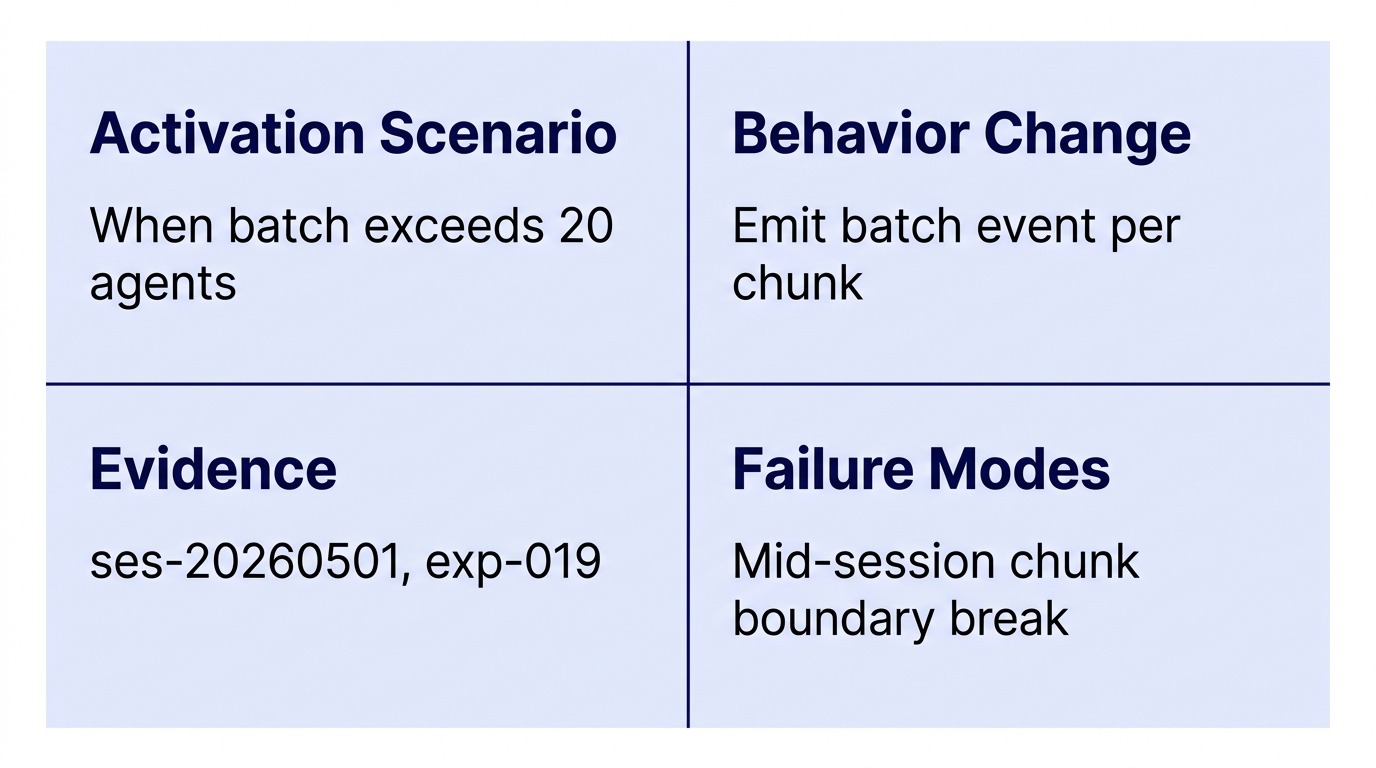
A mechanism entry without all four fields is incomplete. A missing failure mode in particular is the most common defect. It signals that the mechanism was written from a success case, not from a full operating model. Every mechanism will eventually fail at its boundary conditions. Writing the failure mode forces you to think about what those boundaries are before you encounter them under pressure.
The management accounting parallel
Finance has had this discipline for a century. Operations and AI tooling are reinventing it badly because nobody told them the pattern existed.
The audit finding register is a near-direct ancestor of the mechanism registry. Each control deficiency gets typed with a description, a root cause, a management response, an owner, a target remediation date, and follow-up evidence. The finding is not closed until evidence of remediation lands in the file. The structure survives auditor rotation, engagement handovers, and multi-year remediation cycles, because it is a typed artifact rather than a narrative in a report.
The internal control matrix goes one step further. Each process step is linked to an associated control, with typed assertions: existence, completeness, accuracy, cut-off. The control is classified as preventive or detective. A test of operating effectiveness is documented. When the test fails, the control change is documented in the matrix alongside a rationale. The entire system is versioned. The discipline of asking "does this control still operate effectively in the current process?" is a re-test protocol, the same question a mechanism registry prompts you to ask at a quarterly audit pass.
Variance commentary in management accounts is where I first encountered the same failure mode in the wild. A budget variance recurs across three consecutive months. The commentary for each month says "demand was higher than forecast." That is a story, not a mechanism. A mechanism would say: the specific driver, the structural change required to close the gap, and the test that would confirm the variance is resolved. Without the typed structure, the next quarter's analyst inherits the same reforecasting problem with no institutional memory of why the previous responses did not close it.
The pattern is identical across all three disciplines. A typed artifact with explicit fields beats a narrative document for survivability across time and personnel change. Finance has enforcement mechanisms for this discipline: external audits, regulatory review, working paper standards. Operations and AI tooling do not have the same enforcement. That is the gap.
Why experiments rot without a registry
An experiment without a typed mechanism is a story. It has a beginning (we had a problem), a middle (we tried something), and an end (it worked). Stories are useful for communicating. They are poor for storage and retrieval.
When the storyteller leaves, the story degrades. When the audience changes, the story gets reinterpreted. When time passes and context shifts, the original meaning of the story changes. Six months after the experiment, the people who ran it may not remember the failure mode. Eighteen months later, the team that inherited the process may not know the experiment happened.
A typed mechanism is a structure. Structures survive personnel change, context switch, and time because they do not depend on the reader already knowing the story. The activation scenario tells the reader when to apply it. The failure mode tells the reader when not to apply it. The evidence links tell the reader where to look if they want to question the mechanism. None of these require an oral tradition.
In my own build, the shift from prose retrospectives to typed mechanisms happened in April and May 2026, encoded as DEC-009 (the Knowledge Promotion Pipeline decision record). The pipeline works in four stages: observations surface in session notes, observations accumulate into hypotheses in learned-rules.md with an evidence counter, hypotheses with three or more evidence points from separate sessions get promoted to permanent rules in rules.md, and rules with explicit activation scenarios and failure modes get drafted as mechanism entries. The four-stage pipeline is not bureaucracy. It is the minimum structure needed to prevent a one-session insight from silently expiring.
The 12 forgotten recommendations from my own audit were all observations that stalled at stage one. They were noted. They were not typed into hypotheses. They were not promoted. Six months later they were invisible.
The 30-minute starter
Anyone reading this can start a mechanism registry tonight. Three steps.
First, pick one recurring problem in your operation. A process that breaks the same way every month. An insight that surfaces in every retrospective without ever being resolved. A control that generates the same finding in every audit cycle. One problem.
Second, write the four fields for it. Activation scenario: what specific condition causes this problem to recur? Behavior change: what would need to be different in the process for this problem to stop recurring? Evidence: what data, observations, or experiments support that belief? Failure mode: under what conditions would the behavior change fail to resolve the problem?
Do not write these as prose paragraphs. Write them as labeled fields. The format enforces the discipline. A paragraph labeled "activation scenario" will still drift into storytelling if you let it. A field with a one-sentence constraint will not.
Third, save it somewhere persistent and version-controlled. A markdown file in a repository. A row in a structured spreadsheet. A page in an audit working paper file with a version history column. The substrate is less important than the four fields being present and the record being durable.
The first entry in a mechanism registry is cheap. It costs 20 minutes and produces one typed structure. That structure is immediately more durable than any retrospective paragraph written about the same problem.
The compounding
The return on a mechanism registry is not visible at entry one. It becomes visible around entry ten.
At ten entries, the first audit pass becomes possible. Which mechanisms are still active? Which have been superseded by process changes? Which have a failure mode that was triggered and never resolved? The audit pass is cheap when the registry is typed. It is impossible when the equivalent information is scattered across retrospective documents and verbal handoffs.
At fifty entries, cross-engagement patterns begin to appear. The renewal-risk mechanism I built for one product line is structurally identical to the sponsor-triage mechanism for another, with one field changed. That cross-pollination would not be visible if both mechanisms were stored as narrative case studies in separate project folders. The typed structure is what makes the pattern detectable.
This is the compounding return. Each mechanism entry deposits into a shared structure. Future work can inherit from that structure without reconstructing it from oral history. The registry becomes capital rather than overhead at the point where the cost of maintaining it is lower than the cost of the re-learning it replaces.
The audit-finding register becomes more valuable each year it accumulates clean data. The internal control matrix becomes the institutional memory of every process change the function has ever made. The mechanism registry follows the same curve. The discipline of typing, not the tool, is the investment.
Start with one entry tonight.
Part of the Business Process Intelligence series from KG Consultancy.
Strategy and technology are the same decision. Over 15 years in fintech (CTOS, D&B), prop-tech (PropertyGuru DataSense), and digital startups, I have built frameworks that help founders and executives make both moves at once. Based in Kuala Lumpur.
Working on a 0→1 product?
I help founders and operators go from idea to validated product. Let's talk about yours.
Get in touch →